MALTE WOYDT

HOME:    PRIVATHOME:    LESE- UND NOTIZBUCH

ANGE
BOTE
BEL
GIEN
ÜBER
MICH
FRA
GEN
LESE
BUCH
GALE
RIE
PAM
PHLETE
SCHAER
BEEK
GENEA
LOGIE

Arrival City (failed)

“Because arrival cities are so widely misunderstood and distrusted – dismissed as static ‘slums’ rather than places of dynamic change – governments have devoted much of the past 60 years to attempting to prevent their formation. It didn’t begin this way. In the two decades after the Second World War, squatter enclaves were tolerated. .. Then, as urban economies became increasingly informal starting in the late 1960s, and manufacturing economies were no longer always the main destination for rural migrants, governments and international organizations developed an obsession with ‘over-urbanization’. This coincided with a romantized, idealized view of the peasant life popular to Marxist economies and in many corners of academia. … It is worth noting that countries rarely experience economic growth while banning or restricting rural-urban migration: without urbanization, the economy stagnates, and people often starve, … Migration-control laws made life much worse for the poor while creating deep layers of corruption, since migration meant bribing officials; this, in turn, increased the criminality of the arrival city. [S. 56] …

Shenzen, China … In a city of 14 million, only 2.1 million, or 15 per cent, have a Shenzen hukou, which entitles their children to education in the city. Fei and Zhan have no hope of getting one. [S. 59] …

The past decade has seen a dramatic change in official opinions. Still, the demolition of arrival-city slums is all too common a practice in such cities as Mumbai and Manila. These bulldozings destroy the economic and social functioning of the arrival city. Even in cases where evicted slum-dwellers are given rudimentary apartments in tower blocks – a common practice in Asia and South America – it is no longer possible for them to create shops, restaurants and factories [S. 62] …

Brazil, with its hundreds of high-population slums still controlled by narco-gangs, also offers a cautionary tale. Its governments spent decades trying to prevent, remove, isolate or ignore the arrival city, and its inevitable dynamics bit back: if left to its own devices, and deprived of access to the larger political system, the arrival city will generate a defensive politics of its own. In Brazil, it took the form of the drug gang. In Mumbai, it is Hindu nationalism. In the arrival cities of Europe, Islamic extremism. [S. 75] …

Most Westerners do not understand that what is taking place in their cities is a process of rural-to-urban migration. … People move through its neighbourhoods … The downward trend for the place is the opposite indicator of the upward trend enjoyed by the residents themselves. This paradox has created a sense among outsiders that the city’s immigrant districts are poorer or more desperate than they really are, which leads to a misunderstanding of the forms of government investment they really need – a serious policy problem in many migrant-based cities around the world. rather than getting the tools of ownership, education, security, business creation and connection to the wider economy, they are too often treated as destitute places that need non-solutions such as social workers, public-housing blocks and urban-planned redevelopments. [S. 82/83] …

Los Angeles, California … Mario ..,, despite being a successful businessman, the husband of a naturalized immigrant and the father of a young American citizen, he has not yet found a way to become a legal Amercian himself. … In the past, the United States has granted amnesties to large numbers of illegal immigrants, transforming them from informal, non-taxpaying underground workers into legitimate citizens who can invest in their society. [Not any more.] Tens of thousands, if not hundreds of thousands of other Angelos are in similar positions: afraid or unable to put their earnings into their communities, trapped in a netherworld of half-arrived despite being active in the economy. The ambiguous approach to citizenship can have damaging effects on arrival cities, turning them from opportunities into threats. [S. 85] …

Les Pyramides, Evry, France. … Something happens to villagers when they arrive in the French urban outskirts. The culture of transition, that fertile amalgam of village and urban life, is frozen in its early stages, prevented from advancing into permanency, from growing into something that contributes to the country’s economy and culture. The parents often manage the first stage adequately, keeping one foot in the village and one in the city, holding down rudimentary jobs and supporting their villages through remittances. But they are prevented from moving to the usual next stage, from launching any kind of small business, from owning their house, from meshing themselves with the larger urban community – they remain isolated. And their children, fully acculturated, find themselves stuck – in part by a well-documented racism that denies them jobs or higher-education postings on the basis of last names or post codes. … ‘The problem is, that these kids see themselves as immigrants.’ … They didn’t build Les Pyramides with Africans in mind. There are not enough rooms, no place for markets, nothing that people from villages can use to make a start … [S. 235] … In effect, the children were raised on the streets and concrete squares of Les Pyramides, by a community of other African and Arab children and teenagers in similar circumstances, a prentless world that pulled many of them into delinquency, others simply into bitterness and anomie. [S. 238] … ‘There are definitely a lot of problems with discrimination here but people don’t realize that the bigger trouble is that a lot of the people … from the banlieus, don’t have a social network that connects them to French society … And in France, it’s very important to have a network to get into school or to get a job.’ [S. 239] …

Kreuzberg, Berlin. … Compared to their French counterparts, these would seem to be ideal locations: in the centre of the city, closely tied to broader German community and economy, generously provided with social services. But Kreuzberg is not a functioning arrival city by any means. Rather than becoming urban and German, many of its residents seem to become more rural and Turkish, and increasingly removed from the centre of society. … 17 per cent said their marriages were forced – a practice that is dying infast in Turkey but was revived in Germany in response to immigration policies. [S. 244] … The Turks in Berlin are forced into a grotesque caricature of their home country’s life, one build on primitive traditions that no longer exist in much of Turkey, one that is alien to most citizens of Turkey as it is to Germans. … Women have fared better in the squatter outskirts of Istanbul than they have in the Turkish neighbourhoods of Berlin. … Something happens to Turks when they come to Kreuzberg, freezing them in a now non-existent Turkish rural past. This is not intrinsic nature of Turkish society, or the inevitable fate of Turkish villagers arriving in the West. In France, almost all second-generation Turks are fluent in French. In the Netherlands, home ownership and upward social mobility are far more prevalent. In London and Stockholm, Turkish neighbourhoods blend successfully into the city’s mainstream … What is missing from the German arrival city … is citizenship.” [S. 246]

aus: Doug Saunders: Arrival City. How the largest migration in history is reshaping our world. London: Windmill 2010.

Abb.: Michael Cook: Broken Dreams #2, 2010, im Internet.

06/14

30/09/2014 (11:40) Schlagworte: EN,Lesebuch ::

Immigration policy

“To bring in only urban, university-educated elites … is a waste both of human potential and of foreign policy, since the immigrants often get their degrees at universities in their own countries that have been funded by foreign governments to help create medical, legal and technical knowledge in the developing world. If the products of these programs all become hotel desk clerks and roofers in Western cities the entire aid agenda is wasted. … Of ‘chronically poor‘ immigrants in Canada, 41 per cent have university diploma’s. … The Canadian government was surprised to discover that the uneducated relatives of points migrants are faring better economically that the original migrants themselves … [and] when immigrants are brought over without their networks of relatives and village neighbours, they are more likely to become isolated and unsocialized, to fall into criminality or social conservativism.”

aus: Doug Saunders: Arrival City. How the largest migration in history is reshaping our world. London: Windmill Books 2011 (Originalausgabe 2010), S. 91-93.

Abb.: Bathélémy Toguo: The world’s new climax, 2000, Kunstpalast, Düsseldorf.

06/14

07/06/2014 (2:00) Schlagworte: EN,Lesebuch ::

Poor neighbourhoods

“Because arrival cities are so widely misunderstood and distrusted – dismissed as static ‘slums’ rather than places of dynamic change – governments have devoted much of the past 60 years to attempting to prevent their formation. …

[But] people move through its neighbourhoods. … they arrive very poor, … but … [poverty] rates fall sharply, especially during the first decade of residence … Nevertheless, the neighbourhoods themselves often stay poor or even get poorer, … sending its educated second generation into more prosperous neighbourhoods and taking in waves of new villagers. … The downward trend for the place is the opposite indicator of the upward trend enjoyed by the residents themselves. This paradox has created a sense among outsiders that the city‘s immigrant districts are poorer or more desperate than they really are, which leads to a misunderstanding of the forms of government investment they really need – a serious policy problem in many migrant-based cities around the world. rather than getting the tools of ownership, education, security, business creation and connection to the wider economy, they are too often treated as destitute places that need non-solutions such as social workers, public-housing blocks and urban-planned redevelopments …”

aus: Doug Saunders: Arrival City. How the largest migration in history is reshaping our world. London: Windmill Books 2011 (Originalausgabe 2010), S. 55, 81/82.

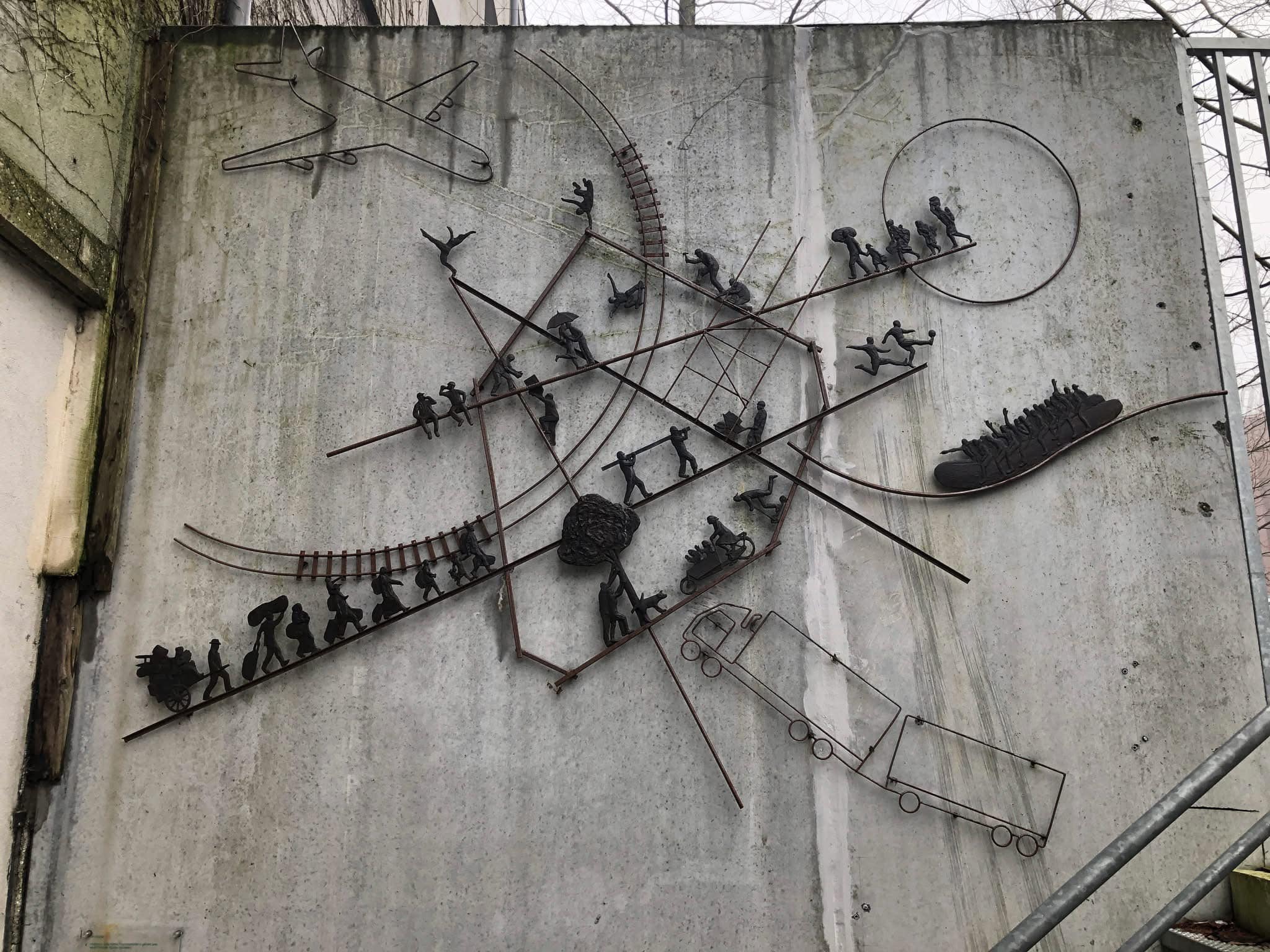
Abb.: Tom Frantzen: Brutopia, Mensen op zoek naar het geluk in Brussel, Migratiemuseum, Foto: brusselblogt

06/14

07/06/2014 (1:46) Schlagworte: EN,Lesebuch ::

City 4

“People had been moving from the country to the city since about 3000 B.C., when the first urban formations took shape around the Persian Gulf and soon spread across Asia and Europe. For the next 5.000 years, countless millions of peasants, and hundreds of thousands of regional elites, made the move to the city …

For most of those 5.000 years, big cities functioned as ‘population sumps … they soaked up large numbers of rural people, held them for a few years and promptly killed them, usually before they could reproduce or settle in any meaningful way … In every major city, deaths outnumbered births, and childhood mortality was especially high … London in the eighteenth century was so lethal that it required an average of 6.000 rural migrants a year just to maintain its population of 600.000. Cities, like armies, destroyed people almost as fast as they could take them in.

In the last half of the eighteenth century, and especially after 1780 or so, the dynamics began to change. … The tightening web of global commerce and communication had created a homogenous human pool of immunity across Europe and much of Asia, rendering formerly lethal epidemic diseases endemic (that is, turning them into mere childhood diseases). The new immunity unleashed an unprecedented population boom. …”

aus: Doug Saunders: Arrival City. How the largest migration in history is reshaping our world. London: Windmill Books 2011 (Originalausgabe 2010), S. 135/136.

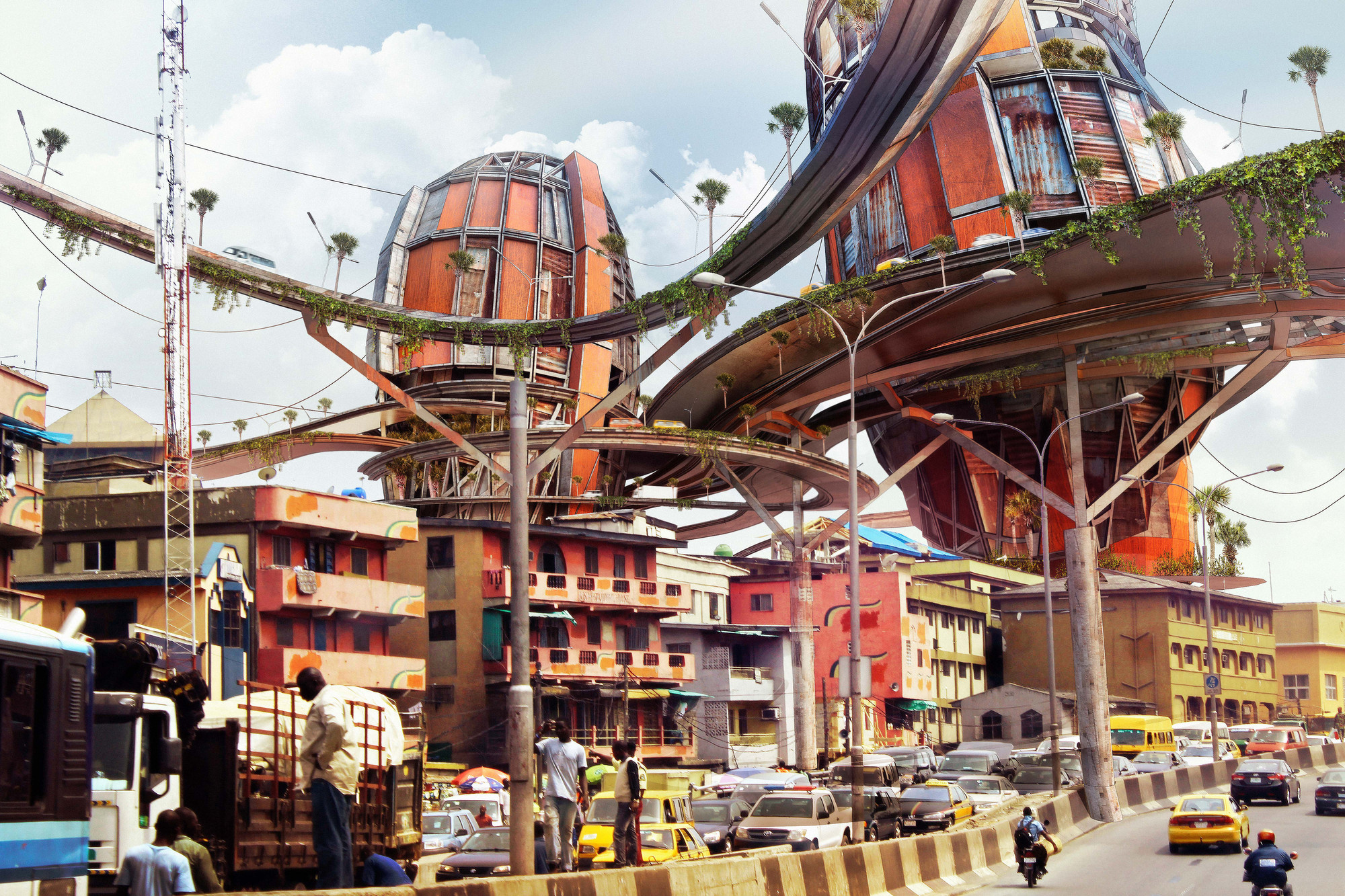
Abb.: Olalekan Jeyifous: Shanty Mega Structures of Lagos Nigeria, 2021, Detail, Moma, im Internet.

06/14

07/06/2014 (1:07) Schlagworte: EN,Lesebuch ::

Village

“To an outsider, the village seems fixed, timeless, devoid of motion or change, isolated from the larger world. We consign it to nature. To those who might glance at its jumble of low buildings from a passing vehicle, the village seems a tranquil place of ordered, subtle beauty. We imagine a pleasant rhythm of life, free from the strains of modernity. Its small cluster of weathered shacks is nestled into the crest of a modest valley. …

in peasant villages around the world, nobody sees rural life as tranquil, or natural, or as anything but a monotonous, frightening gamble. …

At the moment, only 41 per cent of Asians and 38 per cent of Africans live in cities – leaving a population of villagers that is unproductive and unsustainable. They are on the land not because it is a better life, but because they are trapped.”

aus: Doug Saunders: Arrival City. How the largest migration in history is reshaping our world. London: Windmill Books 2011 (Originalausgabe 2010), S. 5,6 und 22

06/14

07/06/2014 (0:47) Schlagworte: EN,Lesebuch ::

Occupy 1

“Despite having sympathy for recent forms of protest like the indignados in Spain or the various forms of ‘Occupy’, there is a reason to be concerned about the type of anti-institutional strategy that they have adopted and that is inspired by the exodus model. … They … believe in the possibility for social movements, on their own, to bring about a new type of society where a ‘real’ democracy could exist without the need for the state or other forms of political institutions. Without any institutional relays, they will not be able to bring about any significant changes in the structures of power. Their protests against the neo-liberal order risk being soon forgotten. …

I find their slogan ‘We are the 99%’ rather unsatisfactory. It might be rousing, but it reveals a lack of awareness about the wide range of antagonisms existing in society and a rather naïve belief in the possibility of installing a consensual society, once the ‘bad’ 1% have been eliminated. …

Jason Hickel … says that Occupy’s structure of non-hierarchical, consensus-based participatory democracy takes the liberal ethic of celebrating diversity and tolerance to its extreme, and that this prevents them from apprehending the nature of power in capitalist societies and the fact of hegemony. Moreover, he sees an anti-political attitude and ‘the liberal ethic in full force’ in their refusal to organise around specific demands, so as not to alienate those who might disagree and discourage diversity. …

By mobilizing a binary rhetoric celebrating the virtues of the free market against the oppressive state, they [neo-liberal advocates] have been able to justify the primacy of the market and the commodification of all social realms, thereby establishing the bases of neo-liberal hegemony. …

Such a negative attitude with respect to the state is also found in some left radical sectors. This convergence can be explained by a shared belief in the availability of a self-regulating society beyond division and beyond hegemony. …

The “horizontalist’ protest movements … celebrate the ‘common’ over the market, but their rejection of the ‘public‘ and all the institutions linked to the state displays uncanny similarities with the neo-liberal attitude. …

The Occupy movement was almost non-existent in France .. In France … the belief in the power of politics to change things has not waned like in other European countries. …

it is high time to stop romanticizing spontaneism and horizontalism.”

aus: Chantal Mouffe: Agonistics. thinking the world politically. London/New York: Verso, 2013, S.77-127.

03/14

26/03/2014 (0:35) Schlagworte: EN,Lesebuch ::

Moralization

“Coming now to your question about the moralization of politics. … The distinction between left and right has been replaced by the one between right and wrong. This indicates that the adversarial model of politics is still with us, but the main difference is that now politics is played out in the moral register. … When the opponents are not defined in a political but in a moral way, they cannot be seen as adversaries, but only as enemies.”

aus: Chantal Mouffe: Agonistics. thinking the world politically. London/New York: Verso, 2013, S.142/143.

Abb.: Eko Nugroho: Ride Your Moral, 2014, im Internet.

03/14

22/03/2014 (23:46) Schlagworte: EN,Lesebuch ::

Second City

“… Now, if Britain was a typical country, you might expect it to have a second city of about five million, which is twice the size of Greater Manchester or the area around Birmingham.

I say this because it has been observed – very loosely it should be said – that the size distribution of cities within countries tends to follow a pattern in which the biggest city is about twice the size of the second city, three times the size of the third city, four times the size of the fourth and so on.

It is named Zipf’s Law after the American linguist George Zipf, who noticed that the frequency distribution of words in many languages followed that pattern.

For the UK, the implication is stark. As the eminent economic geographer from the London School of Economics, Henry Overman, puts it: ‘These kind of arguments imply that the problem with Britain’s urban system is not that London is too big. Instead, if anything, it’s that our cities are too small.’

Our second tier cities in particular. Having cities that are too small is potentially an economic problem because we know that big cities act as hubs which boost whole regions.

We know that cities are where a disproportionate amount of business gets done. And we know that, typically, bigger cities are more productive than smaller ones. …

Hitherto, one might say that the lack of a proper second city has allowed London to divide and rule the rest of the nation. And the argument is even more powerful now that London has become such an obvious global centre.

It is as though Britain has a great world city but lacks a great national one.
So, if you believe this analysis, which second city offers the most hope for taking on the might of London?

Manchester or Birmingham are usually put forward, and the data suggests there is a logic to those two being on the shortlist. …

However, there is an interesting alternative suggestion – Hebden Bridge. It is not a suggestion to take literally, but it does make an important point.

Hebden Bridge, nestling in the Pennines between Manchester and Leeds, is certainly one of the most interesting and flourishing towns in the UK. It was once declared the “fourth funkiest town in the world” (whatever that means) and is often said to be the lesbian capital of the UK. The suggestion that it is Britain’s second city came from resident David Fletcher, who was active in the 80s saving the town’s old mills and converting them to modern use.

His point is that Hebden Bridge is an inverted city with a greenbelt centre and suburbs called Manchester, Leeds and Liverpool.

His point was that the real second city of the UK is a northern, trans-Pennine strip that extends the relatively short distance across northern England, joining the built-up areas that lie second, fourth and sixth in the UK ranking.

Certainly, Hebden Bridge has attracted a lot of professional couples who are split commuters, one heading towards Manchester and one towards Leeds each morning. It is a place that allows both those cities to be treated as next door.

And maybe therein lies some kind of answer to the critical mass of London. It’s not a second city called Hebden Bridge, but a super-city that tries to turn the great cities of the north into one large travel-to-work area.

It would require a lot of physical infrastructure to improve links between the different centres. …”

aus: Evan Davis : The case for making Hebden Bridge the UK’s second city, Mind the Gap: London vs. The RestBBC Two at 21:00 on Monday, 10 March 2014. (siehe ganzen Text auf BBC-Website)

03/14

11/03/2014 (0:42) Schlagworte: EN,Lesebuch ::

Individualization 1

“To sum up: the other side of individualization seems to be the corrosion and slow disintegration of citizenship. Joël Roman … points out in his recent book (La Démocratie des Individus, 1998), that ‘vigilance is degraded to the point of surveillance, engaging collective emotions and fear of the neighbour‘ – and urges people to seek a ‘renewed capacity for deciding together’, a capacity now conspicious mostly by absence.

If the individual is the citizen‘s worst enemy and if individualization spells trouble for citizenship and citizenship-based politics, it is because the concerns and preoccupations of individuals qua individuals fill the public space, claiming to be its only legitimate occupants and elbowing out from public discourse everything else. The ‘public’ is colonized by the ‘private‘; ‘public interest’ is reduced to curiosity about the private lives of public figures and the art of public life is tapered to the public display of private affairs and public confessions of private sentiments (the more intimate the better), ‘Public issues’ which resist such reduction become all but incomprehensible.

The prospects for a ‘re-embedding’ of individualized actors in the republican body of citizenship are dim. What prompts them to venture onto the public stage is not so much a search for common causes and ways to negotiate the meaning of the common good and the principles of life in common, as a desperate need for ‘networking’. The sharing of intimacies, as Richard Sennett keeps pointing out, tends to be the preferred, perhaps the only remaing, method of ‘community-building’. This building technique can spawn ‘communities’ only as fragile and short-lived, scattered and wandering emotions, shifting erratically from one target to the another and drifting in the forever inconclusive search for a secure haven … As Ulrich Beck puts it … : ‘What emerges from the fading social norms is naked, frightened, aggressive ego in search of love and help….'”

aus: Zygmunt Bauman: Individuality, together, Foreword to: Beck, Ulrich / Beck-Gernsheim, Elisabeth: Individualization. London u.a.: Sage 2002, S.xviii.

Abb: Alberto: Giacometti: Man Walking 1, 1960, im Internet.

04/12

27/04/2012 (0:01) Schlagworte: EN,Lesebuch ::

Technocrats

(NL)

“There’s a word I keep hearing lately: “technocrat.” Sometimes it’s used as a term of scorn – the creators of the euro, we’re told, were technocrats who failed to take human and cultural factors into account. Sometimes it’s a term of praise: The newly installed prime ministers of Greece and Italy are described as technocrats who will rise above politics and do what needs to be done.

I call foul. I know from technocrats; sometimes I even play one myself. And these people – the people who bullied Europe into adopting a common currency, the people who are bullying both Europe and the United States into austerity aren’t technocrats. They are, instead, deeply impractical romantics.

They are, to be sure, a peculiarly boring breed of romantic, speaking in turgid prose rather than poetry. And the things they demand on behalf of their romantic visions are often cruel, involving huge sacrifices from ordinary workers and families. But the fact remains that those visions are driven by dreams about the way things should be rather than by a cool assessment of the way things really are.

And to save the world economy we must topple these dangerous romantics from their pedestals. …

So why did those “technocrats” push so hard for the euro, disregarding many warnings from economists? Partly it was the dream of European unification, which the Continent’s elite found so alluring that its members waved away practical objections. And partly it was a leap of economic faith, the hope – driven by the will to believe, despite vast evidence to the contrary – that everything would work out as long as nations practiced the Victorian virtues of price stability and fiscal prudence.

Sad to say, things did not work out as promised. But rather than adjusting to reality, those supposed technocrats just doubled down – insisting, for example, that Greece could avoid default through savage austerity, when anyone who actually did the math knew better. …

But our discourse is being badly distorted by ideologues and wishful thinkers – boring, cruel romantics – pretending to be technocrats. And it’s time to puncture their pretensions.”

aus: Paul Krugman: Eurozone crisis: To save Europe, topple the ‘technocrats’, New York Times Nov 21, 2011 (Internetquelle)

11/11

30/11/2011 (20:53) Schlagworte: EN,Lesebuch ::
« Previous PageNext Page »